Sunday, November 27, 2011

Euthanasia: a slippery slope

Youth in Asia?
It was 1978.  The teaching assistant of my Russian Literature seminar entered the room. He sat down at the table and said, “Today we are going to talk about youth in Asia.”  My classmates and I looked at one another, puzzled. Sensing our confusion, he stood up and wrote ‘euthanasia’ on the chalkboard. “Mercy-killing,” he said. The debate was on. More than three decades later, the debate is heating up.

Last week, the Royal Society of Canada (RSC) released its report, “End-of-life decision making.” The Parliamentary Committee on Palliative and Compassionate Care also released its report. And, there is presently a legal challenge before the Supreme Court of British Columbia that seeks to decriminalize euthanasia.

Link to RSC report: http://www.rsc.ca/creports.php
Link to Parliamentary Commiteee Report: 

Euthanasia, an act of compassion or moral confusion?
Euthanasia, which literally means “a good death,” has come to be defined as “the intentional killing by act or omission of a dependent human being for his or her alleged benefit.”

The proponents of euthanasia seem to value life, just as those opposed to it do. At the heart of the push for the decriminalization of euthanasia is the desire to ease suffering for the dying or the terminally ill and their family. Some would argue that euthanasia is a compassionate action because the elimination of suffering helps people experience a good death. 

But, enshrining euthanasia in law is a dangerous path for a society tread. It can lead to the slippery slope of moral confusion regarding the value of a particular individual’s life. Who decides when a person’s life no longer has value or meaning? Who judges the quality of that life, and on what criteria?

The RSC report recommends that Canada adopt a “permissive yet carefully regulated and monitored system with respect to assisted death.”  Based on evidence from other countries, the RSC dismisses the slippery slope argument. The report states that the decriminalization of euthanasia is not a threat to vulnerable people, nor does it lead to non-voluntary or involuntary euthanasia. 

The Netherlands
These two claims are debatable. The experience of the Netherlands, where voluntary euthanasia has been legal since 1984, suggests otherwise. In 1999, the “Journal of Medical Ethics” published a paper reflecting on the results of a 1995 survey of physicians. The survey found that in 20%, or 900 of 4,500 reported cases, patients did not request or consent to having their life ended. Some of these patients were mentally competent at the time of their death, while others were not. In two-thirds of these cases, the patient and physician had never even discussed euthanasia as a possibility.

The study also revealed that physicians withheld or withdrew life-prolonging treatment in 41 % of 1000 cases of infants under one year of age because they felt the baby’s life would be unbearable. In 20% of these cases, parents were not consulted.

The paper concluded that “the practice of voluntary euthanasia remained beyond effective control,” despite regulated guidelines and the duty to report enshrined in law. Although it was illegal, physicians were carrying out involuntary and non-voluntary euthanasia.

The physicians surveyed were not bad, evil people. They believed they were acting in the best interests of their patients. They were deciding which human life had value, meaning, and quality.

Belgium 
A study published in 2010 in the "Canadian Medical Journal" looked at physician-assisted deaths in Belgium, where voluntary euthanasia has been legal since 2002. That study also found that involuntary and non-voluntary euthanasia was occurring.

Dutch Physicians Association
The Dutch Physicians Association (KNMG) released a position paper on euthanasia this fall. The KNMG paper recommends that non-medical reasons, like loneliness or financial difficulties, should qualify a person for euthanasia. The rationale is that non-medical factors also cause unbearable suffering and affect an individual’s quality of life.

It's a slippery slope
All of this points to moral confusion; the slope seems slippery to me.

In the Christian worldview, life is sacred from conception to natural death. End-of-life decisions flow from this premise. Ordinary medical interventions and treatments must always be taken to preserve life.  Therapies that deliver compassionate and palliative care are essential to preserving the dignity of the dying person and contributing to a good death.

The RSC report acknowledges that Canadians are not preparing adequately for death, and that quality palliative care is not readily available.  The Parliamentary Committee Report makes recommendations for establishing a national system of compassionate and palliative care.  This is the direction in which we should be moving.

If we want to avoid the slippery slope, we need to choose a path based on the spiritual principle that life is sacred, from conception to natural death.


Saturday, November 12, 2011

Reflections for Remembrance Day


Tyne Cot Cemetery by Marc Aert

Since its original inception as Armistice Day in 1919, people in countries around the world gather on November 11 to commemorate the thousands of men and women who died in armed conflicts.

Over time, the international community has developed a set of traditions to mark the day, and to set it apart from other days. We wear poppies on our coats. We lay wreaths. We observe a period of silence. We listen to the roll call of those who died. We express our collective desire for peace. 

Peace - the absence of war or hostilities
Peace is defined as the absence of war or hostilities. The definition of peace suggests the reality that Remembrance Day draws to our attention; the world struggles with peace. The world defines peace by what it is not. Peace in this definition is a political reality; a nation or nations are not at war.

Growing up in Canada, I can relate quite easily to this definition of peace because my experiences of war are vicarious. I know about war not because I have lived through one fought on Canadian soil. I know about war because I have seen images of it on television, read about it, studied it, and listened to the wartime stories of others.

Family stories of growing up during World War II
My father has some fascinating stories about growing up on a farm in northern Italy during the Second World War. He and his family were no strangers to the insecurity that war creates. They lived with hunger, poverty, and a sense of an ever-present danger that accompanies living in a war zone.

Some of his stories are humorous, like the story of the bridge. The German soldiers repeatedly attempted to blow up a nearby bridge to cut off the transportation route. Instead, they repeatedly blew up ground around the bridge, always missing the bridge itself. This was a source of amusement to the villagers, and provided them with lighthearted moments of relief while living with the tension of war. After a time, the villagers began to suspect that the failure to destroy the bridge was a sort of mutiny. Everyone needed the bridge; it was a symbol of the common good.

One of my favorite stories speaks of the persuasive power of conviction. Towards the end of the war, as discipline in the German army broke down, my grandparents routinely assisted German soldiers who were deserting their posts. They did this although they were putting themselves in grave danger.

One day, members of the Black Shirts, a paramilitary Fascist group of armed thugs, descended on the farm. With guns pointed, they demanded that my grandmother hand over the two soldiers the family was hiding. My grandmother calmly told the men to leave. When they refused, looking the leader steadily in the eyes, she revealed the handgun under her apron, and repeated her request. Remarkably, the men backed away. They never returned.

They shared a common humanity
What was it about my grandmother that made such a profound impression on these thugs that they obeyed her? I think it was the strength of her conviction that she, the German soldiers, and the Black Shirts shared a common humanity. Her quiet but strong demeanor unearthed the goodness buried deep beneath the exterior cruelty of this particular group of men. She was the bridge of common decency that rehabilitated these men, at least temporarily.

My grandmother’s actions speak of an unshakeable belief in the inherent dignity of the human person. The German soldiers that she helped were not the enemy, the hated ‘other.’ They were simply young men, not much older than her sons. Like her sons, they too bore the image of a good God, and deserved respect. To hand them over would have been contrary to her belief.

The Universal Declaration of Human Rights
In 1948, as a direct result of the atrocities of World War II, the United Nations adopted the Universal Declaration of Human Rights. The members of the drafting committee came from a broad spectrum of political, cultural and religious beliefs. Despite their differences, Hernan Santa Cruz of Chile, a member of the committee, said they came to this consensus: the supreme value of the human person comes from the very fact of existing, not from belonging to a particular nation or group.
Read Santa Cruz's remarks: http://www.un.org/en/documents/udhr/history.shtml

Remembrance Day is a fitting moment to recall the preamble to the Universal Declaration of Human Rights.  The foundation of freedom, justice, and peace depends on recognizing and honoring the innate dignity, and the equal and inalienable rights of all members of the human family.
Read the Universal Declaration of Human Rights:


Saturday, October 29, 2011

Outer appearances can deceive


Heading off to the costume party
It was costume party day at my children’s playgroup.  Our eldest son, four years old at the time, had decided to be a carpenter. To create his costume, we had dug into my old blue trunk. That trunk had been to university and back with me, but now served the very useful purpose of storing items for ‘dress-up’ play.


We fashioned a simple costume. My son wore a carpenter’s apron and toted a hand crafted wooden toolbox with miniature tools. On his head was an orange plastic Tonka hard hat.  We left our home pleased with his appearance, and headed off confidently to enjoy the party.

My heart sunk when we entered the room; my son's peers were spectacularly and elaborately decked out. Little boys, dressed as dinosaurs and dragons, and little girls, dressed as princesses and fairies, appeared to have sprung fully costumed from the pages of a pop-out storybook. 

Fortunately, my son was oblivious to the inadequacy of his tickle trunk costume. The children crowded around him, drawn to the costume with its miniature tools.

At some level, the children sensed that here was the genuine article, a costume that expressed character. Here was a kid who had helped create his character. In creating the costume, he had become a carpenter. There was nothing remarkable about his costume, but there was integrity in the character.

Learning from a simple carpenter
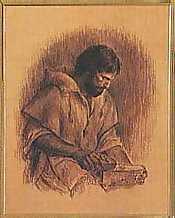
"The Carpenter" by Frances Hook


In the 1st century, in Palestine, a simple carpenter, named Jesus, appeared on the scene. He came from an obscure village and an ordinary family. Based on his position in society, there was nothing to recommend him to others. “He had no form or majesty that we should look at him, nothing in his appearance that we should desire him” (Isaiah 53:2). Yet, he taught and spoke with authority; crowds hounded him, and the religious leaders feared him. 

Jesus had charisma. His character, not his costume, attracted people. His charisma came from his sense of identity as God’s beloved. His self-esteem was rooted in being loved and in loving others. Love informed his words and deeds.

Jesus knew that the people of his time were impressed with good looks, fine clothes, and lavish homes. People viewed these outward externals of success as a reward from God for being good. So Jesus warned his disciples of the deceptive nature of outward appearances. Referring to the scribes, Jesus noted that this group of men liked to parade in long robes and to be greeted obsequiously. They said long prayers “for the sake of appearance” but their hearts were hardened towards the poor and suffering (Mark 12:38-40). 

Cars, homes and clothes may become our costumes
We are not very different from the people of Jesus’s time. We are impressed with appearances. Popular culture bombards us with images of narcissism. The advertising, fashion, and entertainment industries entice us to costume ourselves in imitation of the wealthy and glamorous. Our cars, homes, and clothes may become our costumes; they may project an image not of who we are, but of who we want to be.   We let the externals create our character.

The external things are like spectacular costumes worn to the party. They may be masks that conceal our sense of inadequacy or our feelings of exclusion. Our costumes may be glorious to look upon while our character is bruised or lacking in substance.

Peeling back the costume
Meister Eckhart, a medieval mystic, spoke about the spirituality of detachment. This is the stripping away of possessions, attitudes and sometimes relationships until we have nothing. In nothingness, we discover who we truly are, and we become one with God.

Jesus invited all people to discover the worth of their person. The spiritual life invites us to shed the layers of our costumes and to peel back the mask that conceals our true self. To do so is to undertake the risky journey of discovering the genuine article of our being.


Sunday, October 16, 2011

Beware of pests in the vineyard

A pest in the vineyard
Grape Gathering by Xedos4
My father makes wine, and we often help with the wine making process. One year, we decided that we could improve the wine if we were to pluck the stems from the grape bunches before crushing the grapes. Since we had copious amounts of grapes, plucking the stems was a time intensive, laborious task, but it was well worth the effort. That year’s vintage was outstanding.

I was gratified to learn at a recent tutored wine tasting that some limited edition vintages are created from grapes that are both hand picked and de-stemmed. Even prior to harvest, the vines for these more expensive wines are trellised in a special way to promote the production of high quality fruit.


Still, things can go wrong. Pests can attack the viability of the crop. The louse, for example, attacks the roots. It’s a sneaky little pest whose presence can go undetected for a long time. It is only when the leaves of the vines begin to die prematurely that the disease become obvious. By then, it may be too late to save the vines and the rootstock.


Growers sometimes plant rose bushes in the vineyard among their vines. The rose bush is a natural alarm system alerting growers to pests. If the rose bush looks sick, the grower can assess the problem and take action to save the vines.

Biblical image of the vineyard
The vineyard is a classical Biblical image. In the Hebrew Bible, the prophets used it to describe the relationship of God and the nation of ancient Israel. In the New Testament, Jesus compares himself to the vine. He is the healthy vine; his disciples are the branches. Separated from the vine, the branches lose their vitality. They wither and die.

The images of the vineyard, and of the vine and branches have profound implications for human spirituality. They are images that speak of the human cycle of goodness and sin from which no person or group is exempt. Individuals and groups of individuals, including religious institutions, are at various times, both sinner and saint.

The spiritual rose bush - an interior alarm 
Each one of us has a spiritual rose bush, an inner sense of disquiet that alerts us to a pest in the vineyard of our soul. Sometimes we heed that sense of uneasiness. Sometimes, we ignore it. We may have become so accustomed to it that we no longer even notice the alarm bell ringing.

The first spiritual rose bush is the emerging and developing conscience. Those little pangs of conscience that bothered us as children were indicators of something amiss in our behavior. Parental disapproval and feelings of guilt, remorse or regret prompted us to correct our mistakes.

Wine Taster by Luigi Diamanti
With maturity, the focus of our disquiet changes. We are more reflective and self-aware. When we recognize our inner alarms and act on them, we are like vintners striving to produce a fine wine. We are strengthening our best characteristics, and plucking away at our deficiencies. We are de-stemming that which makes the wine of our life bitter.

As we eradicate one pest from the vineyard, another may appear. When we reflect on our life, we will likely be able to name a number of pests that have threatened the fruit of our branches.

Presently, my spiritual alarm is a feeling of a generalized dissatisfaction with my life, and it always surfaces when I become focused on my self. My ego becomes that sneaky little pest, subtly worming its way into my consciousness, and draining me of vitality.

When I feel dissatisfied for any length of time, I know I need to rebuild the trellis that supports spiritual growth. Prayer, attentiveness to scripture, communal worship, and acts of kindness help to restore me and to create optimal conditions for producing good fruit.

The images of the vineyard and the vine have something to teach all of us. We need to carefully tend our spirituality. When we ignore the spiritual part of our inner being, we begin to suffer some kind of disconnection from our self, from others, from creation, and from the divine. We produce low quality fruit and we end up with lousy wine.

Photo Credits:
"Grapes" by Xedos4:  Courtesy of Free Digital Photos  http://www.freedigitalphotos.net/images/view_photog.php?photogid=1539
"Wine Taster" by Luigi Diamanti: Courtesy of Free Digital Photos http://www.freedigitalphotos.net/images/view_photog.php?photogid=879

Sunday, October 2, 2011

Finding God in the ordinary

Was it coincidence? Or, was grace breaking through my daily tasks?


A good start to the day
"Vineyard" by Stuart Miles
The morning’s work on my blog had gone reasonably well. I was commenting on a passage from the Gospel of Matthew (21.28-32) where Jesus is speaking to the chief priests and elders of the Jewish people. He tells them a story about two sons. The father asks each son to go work in the vineyard. The first son says “No”, but then reconsiders and goes. The second son says “Yes”, but does not follow through. Jesus asks, “Which of the two did the will of the father?” The answer is obvious, and the religious leaders get it right.

Even still, Jesus has some harsh words for this group. Essentially, he compares them to the second son. He tells them that the tax collectors and prostitutes, people who are public sinners, are closer to heaven than they are.

The tax collectors and sinners have contrite hearts. They know that their attempts at being holy are woefully inadequate, but still they search for God in their life. They are like the first son who at first refused to do the will of his father, but eventually sets out to please him.

They are layers of meaning to the story, but I was noodling on the idea that the religious leaders were imposters. They had turned God into a set of rules and regulations to be followed. They had become self-satisfied and complacent about their spiritual state. God had ceased to be a living presence for them. The religious leaders were posers.

Coincidences
In the afternoon, I confidently sat down to pen my column. Several frustrated hours later, I was feeling like an imposter myself, an ordinary woman masquerading as a religion columnist. 

“Give it a rest,” I thought, “Bake some cookies.”
"Chocolate Chip Cookies" by Grant Cochrane

I was sort of listening to the radio program, but mostly I was thinking about my column when I heard something that demanded my full attention.

“I have no idea what I’m doing,” said the voice on the radio. The comment, at that particular point in time, expressed my sentiments precisely.  A discussion on feelings of inadequacy ensued. Many people, despite their competence, expect to be discovered as frauds. The host actually used the word “imposter”.

That word, “imposter”, had been crashing into my consciousness all day. Were the connections between my reflection in the morning, my feelings of frustration in the afternoon, and the topic of this radio show trying to teach me something? 

A new column began to take shape.

Mysticism of ordinary life
In the midst of the commonplace activity of baking cookies, my mind and heart opened to the presence of God.  The little coincidences, all based around the word “imposter”, were a small grace, an exclamation mark in the day reminding me that we can find God in routine tasks.

This is what the Jesuit theologian Karl Rahner referred to as the mysticism of ordinary life.  This is not the traditional concept of Christian mysticism, where union with God is a privileged experience for a very few holy men and women. It is not the dramatic mysticism of ecstatic trances, visions, or spectacular phenomena.  

The mysticism of ordinary life finds God in daily life.  As Rahner expressed it in one of his prayers, “If there can ever be a way for me to you, then it leads through my daily drudge…I must also be able to find you in everything.”
Link to Rahner's spiritual writings. The Daily Drudge begins on page 45. http://www.maryknollsocietymall.org/chapters/1-57075-553-1.pdf

Responding faithfully to the presence of God in everything is not easy. Like the tax collectors and sinners, we sometimes find ourselves saying “no” to God.  Being always conscious of the presence of  God, who is ever present to us, is not easy. Like the chief priests and elders, we sometimes find ourselves forgetting God. We become wrapped up in ‘doing,’ instead of being in relationship with God.

Coincidence inspired insight
The connections around the word “imposter” that day may not have been divine intervention, but those connections certainly helped me to see that God was sharing life with me. The connections inspired insight.

Through the ordinary activity of baking cookies, I realized that God had been present throughout my day. Although I considered myself to be working in the vineyard, I was a little bit like the religious leaders. I had forgotten to be present to God.